By Arnold Ageta
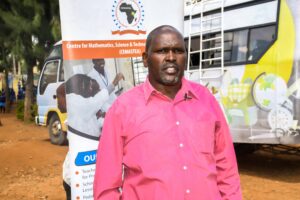
The Coordinator of Special Programs and Student Learning at the Centre for Mathematics, Science, Technology and Education in Africa (CEMASTEA), Joseph Kuria, has encouraged students to embrace the STEM pathway as they choose their careers.
Speaking to the press at Nyamira Primary School after closing the Science, Technology, Engineering and Mathematics (STEM) outreach for Nyamira County, Mr. Kuria said they want to trigger a thirst for science and technology among learners.
“The intention of this outreach is to motivate more learners to have interest in stem subjects so that as they transit to senior school the learners can take up the stem path,” he said.
As a country, he revealed, and within the curriculum reforms, the government intends that 60% of learners transiting from grade 9 to grade 10 should take up the STEM pathway.
He added that by CEMASTEA conducting STEM Outreach, they are able to motivate and create the interest of more learners leaning towards STEM to take up the STEM pathway when they join senior school.
The STEM Outreach programme has been running in Nyamira County for the past five days, covering one Junior Secondary School in each sub-county.
The activities were held in Kebabe Comprehensive School (Nyamira North), Nyambaria Comprehensive School (Manga), Gesibei Comprehensive School (Borabu), Kierira (Kitutu Masaba North), and Nyamira DEB School in Nyamira South.
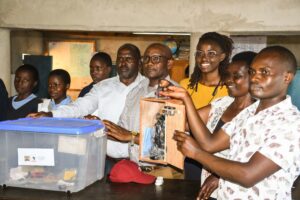
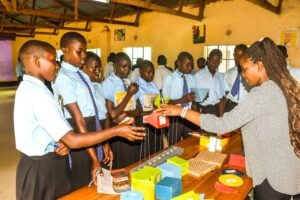
The outreach conducted integrated science, physics, biology, chemistry, and ICT clinics for learners where they received advanced STEM lessons using more simplified methods.
Many learners welcomed the approach, saying it simplifies learning, making it easy to understand and remember.
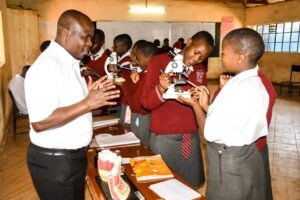
Sharon Kirota, a learner at Nyambaria Junior Secondary, says she enjoyed the teaching methods which, according to her, were easy to grasp. She adds that she was able to use the microscope to draw and name the parts of a plant cell, as opposed to before using the microscope.
“I am now contented that if a question is set about parts of a plant cell I will correctly answer it,” she said. “I am able to name all the apparatus used in Chemistry and Physics.”
Her principal, David Okemwa, welcomed the STEM Outreach, saying his learners and teachers enjoyed the lessons and hopes that more of the same will be conducted in his school in the near future.
“The most exciting part is the practical bit where learners were able to use various apparatus to conduct lab tests and get results,” he said.
Mr. Okemwa urges the government to increase capitation or supply STEM laboratory equipment so that learners can get hands-on skills instead of learning theoretical parts only where improvisation of apparatus is impossible.
“We just mention some of these equipment to our learners but today they have seen and interacted with them and it is a memorable experience for them,” he noted.
Magombo Curriculum Support Officer, George Nyabero, under whose zone Nyambaria Junior School falls, agrees with Principal Okemwa that learners need to be taken through STEM practical activities for it to make meaning in their studies.
He says theory alone cannot make STEM learners embrace the pathway, as it becomes very difficult when they transit to senior schools.
“Our teachers have been retooled and the best pedagogical approach is learner centered where learners are given opportunity to use the apparatus as we have seen them do today,” he confirmed.
Mr. Nyabero said when they are given a chance to manipulate apparatus and engage teachers, the learning experience is good and enjoyable.
“Our teachers have also witnessed how teaching lessons can be made learner centred where learners are guided and facilitated using various methods,” Nyabero observed.
He believes that if junior schools are well equipped, many learners will be motivated to embrace the STEM pathway.
Rebecca Komenda, a STEM teacher from Nyambaria Junior School, agrees with them that learners enjoy participatory learning where they are given an opportunity to conduct lab tests.
“CEMASTEA approach to STEM makes students incorporate real happenings into classroom making lessons enjoyable,” she noted.
She however noted with concern that many learners have fear and a negative attitude towards STEM, believing that the pathway is difficult.
“We need to tackle fear and attitude and make lessons more interesting so that many can pursue STEM pathway,” she said.
Joash Ongaro, the principal of Kebabe Junior School who also teaches Biology, acknowledged the efforts CEMASTEA is playing in sensitizing learners to choose the STEM pathway.
He observed that the learners enjoyed the lessons from the CEMASTEA team, who did challenge him to get enough materials and equipment for STEM.
“I witnessed the learner centered teaching which is an eye opener to both teachers and learners and if it is implemented fully in our schools, I see Kenya having quality STEM standards,” he said.
CEMASTEA’s Kuria observes that many schools have not been able to develop laboratories, but science is possible in our schools even within scarce resources.
“Teachers can improvise what is readily available from the environment and buy some of the resources before the government provides to ensure that integrated science is well conducted through practical activities in our schools,” he opined.
These practical activities, he said, will enhance the mastery of the content by the learners, which will help them to develop more interest in pursuing the STEM subjects in senior school and pursuing STEM careers later in their lives.
“So this is a program within CEMASTEA activities that is charged with the responsibility of promoting stem activities,” he said. “The program also involves teachers as they interact with the learners so that they can see that science is possible in our schools.”
He said that the government’s intention of the curriculum reforms is that 60% of the learners should take up STEM, and CEMASTEA’s approach is a form of motivation and engagement of learners through practical activities.
“I know the numbers are below the 60% but with more engagement with learners through practical activities, we are anticipating a situation where more and more learners we shall be able to attain the 60%,” he said.
CEMASTEA donated assorted laboratory equipment to the schools where they conducted the outreach, including light microscopes which will boost learning in junior schools.
So far, CEMASTEA has covered about 20 counties, including five counties they had planned to visit this year.
“Nyamira county is the last county in our performance contracting for this year,” he confirmed. “And within each county we visit five schools.”
He says that their intention is for the schools to have a multiplier effect, feeling motivated with more learners excelling in science and mathematics so that other schools can benchmark from them.
“For those who are not able to experience this chance, there is the option of schools visiting our centre in Nairobi to master and interact with further innovative teaching-learning activities,” he said.
Kuria said that the program has been received very well all over the 20 counties they have covered, and teachers have appreciated the activities that learners were taken through because they were derived from the curriculum designs.
“They have appreciated that science can be done through practical activities that can easily be developed by the teachers,” he concluded.
CEMASTEA is a state corporation under the Ministry of Education, established in 2004 to strengthen mathematics and science education.