By Arnold Ageta
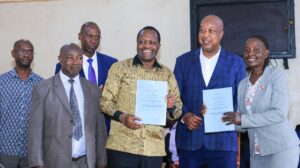
The County Government of Nyamira has signed a Memorandum of Understanding (MoU) with the National Museums of Kenya and the State Department of Education to introduce indigenous vegetables into secondary school feeding programmes.
The partnership, launched at Kebirigo Boys High School, aims to diversify the diet of students in secondary schools, who have traditionally been served a standard menu of sukuma wiki (collard greens), cabbage, and beans.
Governor Amos Nyaribo stated that the initiative will initially kick off in 15 schools across the county, with plans to scale up the number as the programme expands.
“This is a programme that resonates very well with our UjiAfya Masomo Bora Programme for PP1 and PP2 learners in our ECDE centres,” the Governor announced.
He added that the high nutrient content of indigenous vegetables would significantly boost learners’ academic performance.
Governor Nyaribo urged local farmers, many of whom are also parents, to increase the cultivation of indigenous vegetables. He noted that the project would create a reliable source of income to help them pay school fees and meet other household needs.
“As a government, we will stand with you, encourage you to spread this message to other farmers, and provide more training on indigenous vegetable farming,” he said.
He emphasized the need for total farmer involvement to ensure sustainable production, warning against potential deficits once the project gains momentum.
“We want a continuous supply of these vegetables once the programme takes effect, and a continuous supply calls for farmers to grow more,” he noted.
The Governor thanked the National Museums of Kenya for coming up with the initiative and pledged his administration’s full support to ensure its success for the sake of the students.
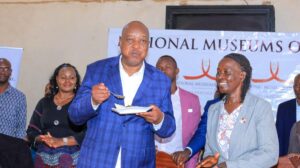
During the launch, a variety of indigenous vegetables were served. The Governor led county officials, teachers, and students in a tasting session, with learners enthusiastically welcoming the new diet.
Janet Nyasani, an indigenous vegetable farmer and member of the Community Resilience and Empowerment Initiative (CREI), lauded the initiative, noting that it opens up a lucrative new market for local producers.
“We have been growing indigenous vegetables for a long time, but the lack of a ready market was a major bottleneck. Today, we thank the government for introducing this brilliant idea of feeding secondary school children with indigenous vegetables,” Ms. Nyasani said.
She added that following the signing of the MoU between the County, the Ministry of Education, and the National Museums of Kenya, farmers will now sign direct supply contracts with schools, guaranteeing them a steady income.
According to Ms. Nyasani, local farmers who previously dedicated small patches of land to these crops will now need to expand their acreage to meet the anticipated surge in demand over the coming months.
“Schools have traditionally fed students on cabbage and sukuma wiki. Now, they have seen the immense value of improving nutrition by incorporating indigenous vegetables,” she observed.
She further pointed out that due to the adverse effects of climate change, traditional maize farming, long relied upon for both food security and income, is no longer viable in the region.
She argued that indigenous vegetable farming has proven to be far more profitable, a benefit that will only increase with the new school supply chains.
“Within three months, indigenous vegetables are ready for harvest and sale, as opposed to maize farming which takes up to eight months with no guarantee of a good harvest,” Ms. Nyasani observed.
However, she highlighted access to quality inputs as a big challenge.
“The only challenge we are currently facing is the scarcity of clean, certified seeds for these indigenous varieties. Without them, we face poor yields,” she said, urging fellow farmers to strictly source clean seeds to ensure high-quality, highly nutritious harvests for the schools.
Ms. Nyasani expressed optimism that the project will be sustainable and scalable, allowing farmers to reap maximum benefits from a venture that has historically been looked down upon.
Speaking at the event, Dr. Evans Taracha, the Programme Coordinator from the National Museums of Kenya, said that high school students would soon become the primary ambassadors for African indigenous foods.
Dr. Taracha emphasized that convincing students to embrace these meals required concrete scientific backing.
“This necessitated a 30-year collaborative research project conducted by the National Museums of Kenya alongside various local universities,” he explained.
He revealed that Nyamira was intentionally selected as the pioneer county for the rollout. Trans Nzoia County is slated to be the second beneficiary, with its launch scheduled for the end of the week.
According to the research findings, Dr. Taracha noted, indigenous vegetables significantly enhance both physical health and mental alertness in learners.
“Strong minds, strong bodies, indigenous vegetables give you both,” he stated. “In the fullness of time, these students will become ambassadors of African indigenous vegetables, influencing society not just in Nyamira, but wherever they go. They enhance cognitive ability, helping students think clearly and learn quickly, which ultimately boosts their grades.”
Meanwhile, prior to the launch event, Governor Nyaribo flagged off the murraming and grading of the Kebirigo Ring Road and officially opened two new ECDE classrooms at the Kebirigo Primary ECDE Centre.